Sustainable Management
As a socially responsible organization, "Export Credit Agency of Kazakhstan" JSC conducts its activities based on the principles of transparency and ethics, understanding that to a certain extent it has an impact on the economy, society, and the environment. In its operations, the ECA is guided by sustainable development principles and strives to achieve a balance between socio-economic and environmental development, while also adhering to the principles of the UN Global Compact. In 2019, the Sustainable Development Policy of the ECA was adopted (Resolution of the Board of Directors No. 48 dated November 20, 2019). In accordance with the Policy, the ECA established long-term targets in specific areas and developed an Action Plan for the implementation of the specified Sustainable Development Policy for 2020–2021 to integrate sustainability considerations into the ECA's business processes.
The ECA ensures the alignment of its economic, environmental, and social goals for long-term sustainable development.
Economic Responsibility
- Ensuring the interests of the Sole Shareholder
- Break-even operation of the Company
- Increasing process efficiency
- Promoting the development of the non-resource economy, including export growth of non-resource sectors and goods
- Zero tolerance for corruption
Social Responsibility
- Ensuring transparent competitive procedures and equal employment opportunities
- Fair remuneration and respect for employee rights
- Training and professional development of employees
- Implementation of internal and external social programs
Environmental Responsibility
- Minimizing the impact on biological and physical natural systems
- Optimal use of limited resources
- Application of resource-saving technologies
Key tasks facing the ECA that contribute to its commitment to sustainable development include improving economic efficiency, growing non-resource exports of goods, works, and services, developing human resources and ensuring stability in working conditions, maintaining high standards of safety, and achieving effective, ongoing engagement with stakeholders.
Achieving strong economic and social performance over the long term is only possible through respecting the interests of shareholders, the state, employees, suppliers, clients of the ECA, financial institutions, and other stakeholders.
Corporate Governance Code of JSC “Export Credit Agency of Kazakhstan”
Code of Business Ethics of JSC “Export Credit Agency of Kazakhstan”
Anti-Corruption Policy of JSC “Export Credit Agency of Kazakhstan”
Sustainability Policy of JSC “Export Credit Agency of Kazakhstan”
Human Rights Policy of JSC “Export Credit Agency of Kazakhstan”
Methodology for Calculating Greenhouse Gas Emissions of JSC “Export Credit Agency of Kazakhstan”
The ECA considers climate and environmental aspects as an integral part of a sustainable export strategy. As part of implementing the ESG approach and its commitment to the principles of the Net Zero Export Credit Agencies (NZECA), the agency is focused on strengthening the climate resilience of its export portfolio.
During the reporting period, the ECA’s portfolio did not include projects that fully met the criteria for “green” investments established by international taxonomies (including the EU Taxonomy and ICMA Green Bond Principles).
At the same time, taking into account international practice (in particular, the ICMA Climate Transition Finance Handbook and OECD Transition Finance Guidance), the ECA integrates into its strategic planning the assessment and support of transition projects aimed at:
-
reducing the carbon intensity of production processes;
-
improving energy efficiency;
-
modernizing assets in line with climate goals.
The ECA plans to develop and implement a methodology for determining the share of transition projects and may also establish an ESG filter for new export applications.
In 2025, it is planned to create an internal register of climate risks, as well as to launch a cross-functional mechanism for assessing transition initiatives.
The absence of green projects in the current portfolio reflects the industry-specific nature of export support. At the same time, the high share of carbon-intensive sectors may pose climate and transformation risks (including stricter regulations, access to international financing, and reputational risks).
To mitigate these risks, the ECA plans to:
-
identify transition and potentially green projects;
-
take climate aspects into account when underwriting new applications;
-
establish an ESG rating or indicative assessment scale for export projects.
As of the end of the reporting period:
-
Share of green projects in the ECA portfolio: 0% (according to current taxonomies);
-
Share of transition projects: under assessment (methodology in development);
-
Target for 2025–2027 — implementation of a monitoring system for the climate characteristics of the portfolio and annual disclosure of the share of projects contributing to emissions reduction and the transition to a low-carbon economy.
In 2025, a methodology for calculating greenhouse gas (GHG) emissions was approved, calculations for Scope 1, Scope 2, and Scope 3 were carried out, and portfolio emissions were assessed for the first time.
Special attention is paid to Scope 3 emissions associated with supported export projects, which makes it possible to determine the carbon profile of the portfolio and form the basis for future decarbonization targets.
GHG emission calculations were performed in accordance with international practice and are based on the following principles:
In 2025, the Export Credit Agency (ECA) continued to develop its GHG accounting and disclosure system as part of its climate strategy and international sustainability reporting standards.
Emissions are calculated in accordance with the GHG Protocol and the internal approved methodology for calculating greenhouse gas emissions.
In the reporting year, emissions were assessed on a systematic basis for the first time across key categories:
-
Scope 1 – Direct emissions arising from sources owned or controlled by the Agency;
-
Scope 2 – Indirect emissions associated with the consumption of purchased electricity and heat;
-
Scope 3 – Other indirect emissions, including those associated with supported projects and portfolio activities.
Establishing a baseline emission level enables the ECA to subsequently monitor the dynamics of its carbon footprint, identify priority areas for its reduction, and set long-term decarbonization targets.
The applied approach complies with the requirements of GRI 305, IFRS S2, and the strategic goal of the Republic of Kazakhstan to achieve carbon neutrality by 2060.
Direct CO₂ Emissions (Scope 1)
GRI 305-1, 201-2
Scope 1 includes direct GHG emissions arising from sources owned or controlled by the ECA.
The Society does not independently operate official vehicles and does not incur direct expenses for the purchase and consumption of fuels and lubricants (F&L). Transportation services are provided by an external service provider who, under contractual obligations, ensures the maintenance and repair of vehicles, their servicing, insurance, provision of F&L, and other related services.
Due to the lack of operational control over vehicles and fuel consumption, emissions associated with the provision of transport services do not qualify as direct ECA emissions (Scope 1). Such emissions are treated as indirect and are reflected under Scope 3.
Given the absence of production processes, own fuel combustion sources, and other facilities under the operational control of the Society, direct greenhouse gas emissions (Scope 1) were absent in the reporting period.
Indirect CO₂ Emissions (Scope 2)
GRI 305-2, 201-2
Scope 2 covers indirect greenhouse gas emissions resulting from the ECA's consumption of purchased electricity and heating energy.
The main sources are electricity consumed in office premises and heat energy received from external suppliers.
Indirect emissions were determined in proportion to the share of the leased area in the total volume of the building.
-
Leased area: 2,387.4 m²
Table 16. Resource Consumption and Scope 2 Calculation for 2025
| Resource | Unit | Indicator |
| Thermal energy | Gcal | 215.89 |
| Electricity | kWh | 349,474.23 |
| Total indirect CO₂e emissions | t CO₂e | 448.73 |
Following the results of 2025, total indirect emissions amounted to: 448.73 t CO₂e
The building is equipped with energy-saving systems and resource control sensors, which helps reduce the environmental load.
The obtained data is used for internal monitoring and planning measures to reduce environmental impact.
Other Indirect CO₂ Emissions (Scope 3)
GRI 305-3, 201-2
Scope 3 includes other indirect greenhouse gas emissions that occur outside the direct operational control of the ECA but are associated with its activities.
For the Agency, the main sources of Scope 3 are:
-
business trips of employees;
-
business travel;
-
emissions associated with supported export projects;
-
portfolio emissions by clients;
-
official vehicles used to service management and employees.
For financial organizations, Scope 3 is the most significant part of the carbon footprint.
Business Trips and Travel (GRI 305-3)
In 2025, the ECA assessed indirect emissions associated with official trips of employees and management.
The calculation was performed for major modes of transport using international emission factors and includes air, rail, and road transport.
Table 17. Scope 3 Emissions by Business Travel
| Mode of transport | Distance assessment | Emissions, t CO₂e |
| Air transport | 1,017,023 km | 202.47 |
| Rail transport | 10,694 km | 0.38 |
| Road transport | 10,444 km | 1.79 |
| Official vehicles | 134.7 | 24.25 |
| Total | — | 228.80 |
*The calculation is managerial and indicative in nature, performed on the basis of available source data using a number of assumptions regarding routes, distances, resource consumption volumes, and emission factors. The data obtained make it possible to estimate the order of magnitude of greenhouse gas emissions and are used for internal monitoring, analysis of climate impact, and planning measures to reduce it.
When disclosing Scope 3 emissions, the Society separately distinguishes operational emission categories and Category 15 "Investments". To eliminate double counting, Category 15 emissions are disclosed separately in this report and are not included in the aggregate operational Scope 3 emission indicator.
The obtained data is used for internal monitoring of the climate impact of business trips and the formation of emission reduction measures, including optimizing business trips and expanding the use of remote interaction formats.
Portfolio Emissions (Category 15: Investments)
GRI 305-3, 201-2
For a financial organization, the bulk of indirect emissions is generated by supported projects and the client portfolio.
In 2025, the ECA began phased formation of a portfolio emissions accounting system based on data provided by exporters, as well as industry coefficients and methodological assumptions.
Table 18. Calculation of Downstream Scope 3 Portfolio Emissions
| No. | Company | Industry | Approximate total emissions, tCO₂e |
| 1 | AIIG Kazakhstan | Primary processing of seed cotton into cotton fiber | 741.83 |
| 2 | Green Capital Kazakhstan | Vegetable production | ~5,100 |
| 3 | ALTAI MAI | Oil and fat business | 466.7 |
| 4 | ASTANA TITAN | Non-ferrous metal waste recycling | 150 |
| 5 | Shin-Line | Ice cream production | 6,753 |
| 6 | Prombaza-7 | Production of oils and meal | 5,684 |
| 7 | Talas Investment | Chemical industry | 0.08 |
| 8 | Qaragandy Power Silicon | Electricity | 981 |
| 9 | Terra | Livestock farming | 496 |
| 10 | Kokshetau-Melinvest | Agriculture | 42 |
| 11 | Kyzyltu Flour Milling Plant | Agriculture | 44 |
| Total aggregate ECA emissions (approximate data): | 22,400 tCO₂e |
*Note
Calculations were made using the downstream Scope 3 formula. For downstream Scope 3, only emissions associated with the activities of supported companies that are not included in the ECA's Scope 1 and Scope 2 are considered. All assumptions and exclusions are fixed for internal control.
For each project, Scope 1 (direct emissions) and Scope 2 (indirect emissions from purchased energy) are determined. If Scope 1 is absent (e.g., AIIG Kazakhstan LLP), only Scope 2 is accounted for.
Emissions are adjusted by the ECA's share of participation (attribution factor).
Support for the non-raw material sector and "green" projects (e.g., husk processing) reduces carbon intensity and promotes the transition to waste-free production. Even if a project is not entirely "green," waste reduction and energy efficiency technologies have a positive impact on the climate.
Calculations take into account only real emissions, and methodological assumptions are documented.
At the first stage, projects from various industries were taken into account; the majority of exporters are small and medium-sized businesses facing GHG disclosure for the first time.
Based on the 2025 portfolio disclosures, we note that not all companies are included, and the final data is indicative.
The presented indicators are estimated in nature and are used for internal analysis of the portfolio structure, assessment of climate risks, and formation of approaches to supporting low-carbon and transition projects.
Since 2017, the Company has been a member of the UN Global Compact, the broadest international initiative in the field of social responsibility, which unites more than 12 thousand companies from more than 160 countries. The Global Compact declares ten principles in the area of human rights, labor relations, environmental protection and the fight against corruption, which its participants voluntarily adhere to. The Global Compact calls on participants to support the UN sustainable development goals aimed at improving the well-being of present and future generations.
Human Rights
Companies should support and respect the protection of internationally proclaimed human rights.
Companies should not be complicit in human rights abuses.
Labour Relations
Companies should support freedom of association and real recognition of the right to collective bargaining.
Companies should advocate the elimination of all forms of forced and compulsory labor.
Companies should advocate for the complete eradication of child labor.
Companies should advocate the elimination of discrimination in labor and employment.
Environment
Companies should support a precautionary approach to environmental issues.
Companies should take initiatives to increase responsibility for the state of the environment.
Companies should promote the development and diffusion of environmentally sound technologies.
Anti-Corruption
Companies should confront all forms of corruption, including extortion and bribery.
One of the Company's core values is responsible business conduct. The Company adheres to and shares the principles of international declarations on human rights, labor relations, anti-corruption, and environmental protection, including the OECD Guidelines for Multinational Enterprises.
The principles of these international documents are enshrined in the Company's internal regulatory documents and integrated into the Company's business processes.
The main thing that determines the success of each company is its employees. The reputation, authority, successful and sustainable development of the company depend on each of us. The Company pays great attention to providing a favorable psychological climate and creating conditions for realizing the potential of each employee. The Company has a Code of Business Ethics (hereinafter referred to as the Code) developed in accordance with the best international practices.
The Code is one of the most important tools of corporate culture. Corporate values and guidelines set out in the Code require every employee to be consciously active and proactive. Adherence of all employees to the same principles and standards of behavior contributes to the formation of a reliable and highly professional team united by common goals, culture of behavior and traditions, and also helps to maintain a proper level of mutual understanding both within the company and with business partners and clients.
Working in the Company provides for strict compliance by all employees with legal, ethical and professional norms and standards that meet the requirements of the state, the market and society, and form the basis of the term "compliance". The Сompany adheres to the principle of non-acceptance of corruption in all forms and corruption manifestations in the implementation of both operational and other types of activities.
Stakeholder engagement is one of the key components in the business process organization system. ECA strives to build long-term, fruitful, trust-based, mutually beneficial, and partner relations with its stakeholders—shareholders, employees, suppliers, clients, as well as government authorities.
ECA builds its relations with stakeholders based on the principle of corporate social responsibility. Projects supported by ECA give a new impetus to the development of domestic enterprises and contribute to increasing the export of domestic goods, works, and services.
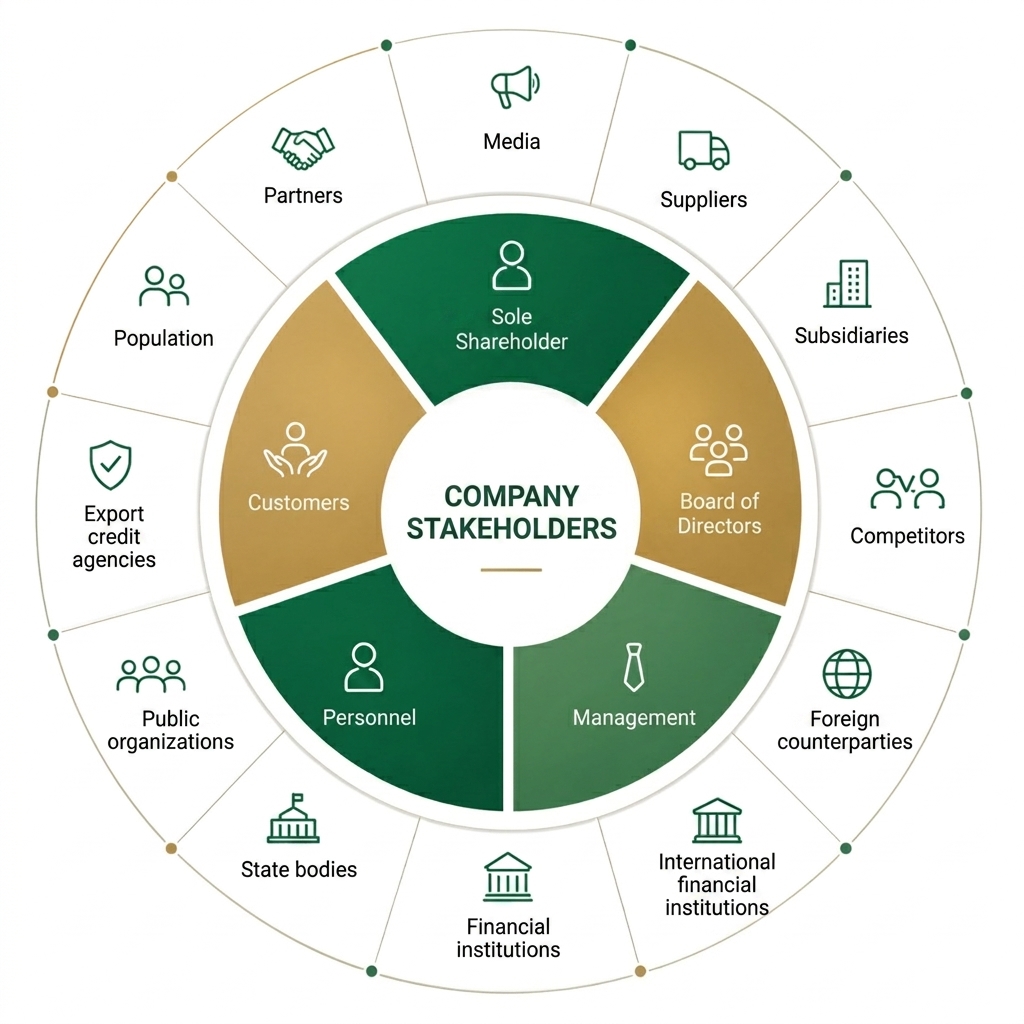
Building trust-based relations with stakeholders is achieved by providing transparent reporting. ECA strives for long-term mutually beneficial cooperation and endeavours to consider all interests and expectations of all stakeholders.
Considering the diversity of our stakeholders, whether an individual or a large organization, ECA applies various interaction mechanisms for everyone.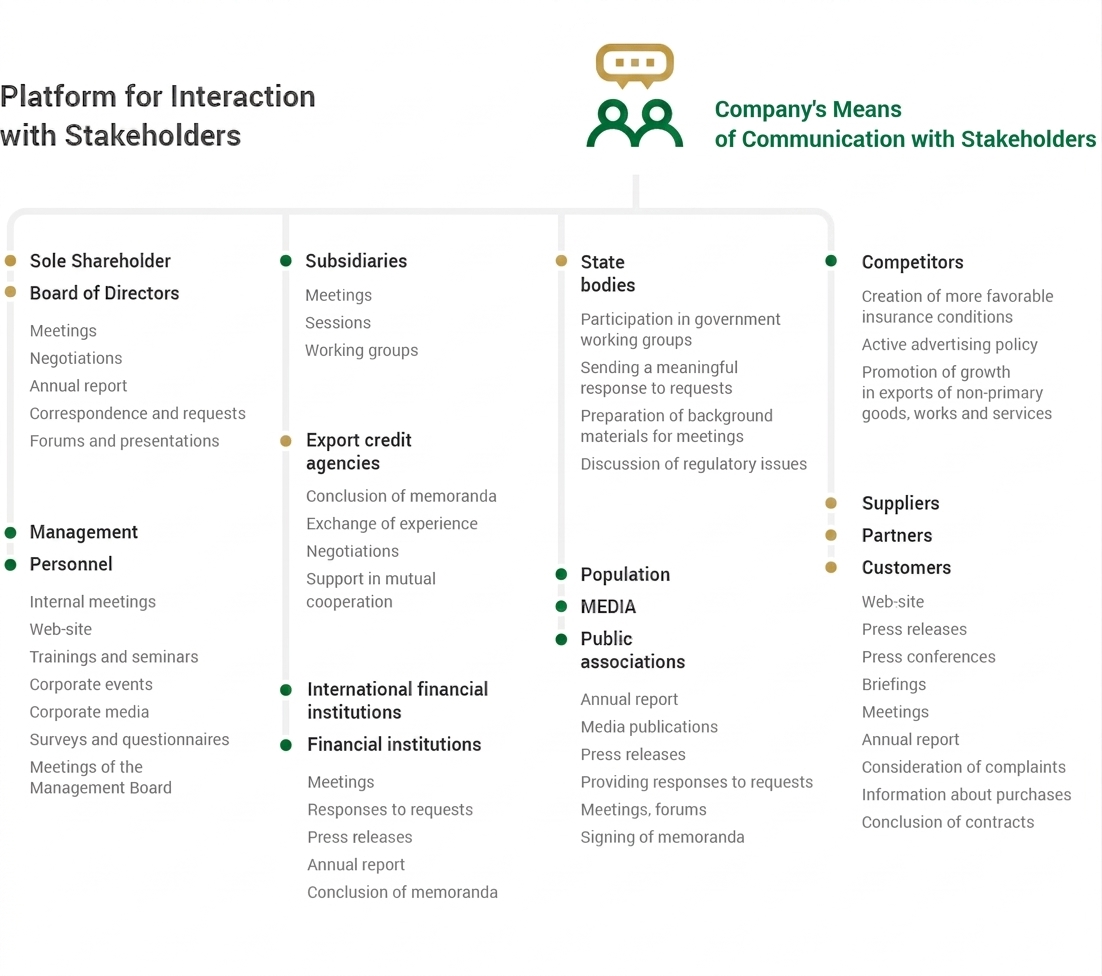
Forms and Communication Channels
Engagement with stakeholders is carried out through the following forms and communication channels:
- official corporate reporting and information disclosure;
- meetings of the Board of Directors and committees;
- business meetings, negotiations, and roundtables;
- participation in industry forums and international events;
- official correspondence and electronic document management;
- digital channels, including the corporate website and exporter's personal account;
- surveys, questionnaires, and feedback;
- hotline and feedback/appeals handling channels.
Stakeholder Participation in Sustainable Development
Stakeholders participate in shaping the Agency's approaches to sustainable development through regular consultations, surveys, business meetings, and expert discussions.
The opinions of key stakeholders are taken into account when determining material ESG reporting topics, defining strategic priorities, expanding the product line, and improving exporter support mechanisms.
Interaction with clients, banks, government authorities, and international partners is of particular importance in developing new financial and insurance instruments, ESG initiatives, and risk management approaches.
The Company is a socially responsible company; being aware of our responsibility to all stakeholders, we pursue a socially oriented policy in environmental protection, regulation of labor and employment issues.
The Company operates in strict accordance with Kazakhstan legislation.
The principles of fundamental international documents in the area of human rights are enshrined in the Code of Business Ethics of EIC "KazakhExport" JSC, internal regulatory documents of the Company, and are integrated into corporate business processes.
The Company expects all its partners, suppliers and customers to recognize fundamental human rights and freedoms and to follow these fundamental principles of human rights in their activities.
The Company has all necessary procedures in place to respond promptly to complaints and claims in the area of human rights.
The main asset of the Company is highly professional personnel, motivated to work effectively.
Success in professional activity and teamwork of each of the Company's employees depends on the amount of knowledge and skills they possess. The Company provides its employees with opportunities for continuous improvement of their abilities and skills. A key aspect of the personnel training and development policy is the internal growth and professional development strategy.
During the quarantine period, a distance learning system is actively used, which contains a large number of corporate courses and multimedia manuals, providing quick and convenient access to knowledge for employees.
Corporate culture is an important link in the Company's activities, an integral component of the Company's successful development strategy. It is based on the main guidelines and values that the Company adheres to when interacting with personnel, partners and customers.
Among the key initiatives in corporate culture of the Company, the following areas can be listed:
- Business Ethics
- Internal communications and personnel involvement analysis
- Corporate events
Internal communication or personnel involvement is an integral part of the Company's corporate culture and one of the main factors for improving performance. Today, the Company focuses on timely informing personnel about key changes, projects and events taking place in the Company, supporting cooperation and sharing knowledge between departments.
In order to correctly determine the direction of further development of the corporate culture and internal communications system, the Company regularly conducts sociological research. Research allows to assess the level of awareness and satisfaction of employees with personnel and social programs, identify areas of potential and existing risks, and make recommendations for the development of personnel and social policies of the Company.
The Company's line of business does not belong to the category that has a negative impact on the environment. The Company strives to use natural resources efficiently, thereby setting an example to all stakeholders.
The climate agenda evolves annually, and proposals for regulating and accounting for greenhouse gas emissions continually emerge.
Greenhouse gas (GHG) accounting, which measures the emissions of companies and other entities, was introduced in the late 1990s. However, interest in this field has surged in recent years due to the rise of both voluntary and mandatory corporate climate disclosure initiatives.
GHG disclosure is essential for climate mitigation and accountability. It plays a key role in achieving ambitious emission reduction targets. To prevent the worst effects of climate change, global greenhouse gas emissions need to be halved by 2030, with the ultimate goal of reaching net zero. Reducing emissions starts with accurate greenhouse gas accounting.
GHG accounting, also referred to as carbon accounting, relies on standardized methods and follows agreed-upon protocols. These methods enable companies, governments, and individuals to measure emissions from their direct operations as well as indirectly through their supply chains and customer bases.
Corporate GHG accounting is crucial, as businesses are major contributors to greenhouse gas emissions. Accurate carbon reporting by companies has become one of the most critical forms of reporting, influencing their investment appeal.
Background information:
The GHG Protocol (Greenhouse Gas Protocol) is a set of industry standards and tools designed for greenhouse gas (GHG) accounting. It is an international framework used to understand, quantify, and manage GHG emissions.
According to the Protocol, a company's emissions are divided into direct and indirect emissions, which are further categorized into three scopes: Scope 1, Scope 2, and Scope 3.
This classification system is typically adopted by large corporations that provide products or services to global markets.
What types of emissions must companies measure and disclose?
To fully understand their climate impact, companies need to measure emissions not only from their own operations but also from the raw materials they purchase and the emissions produced during the use of their products. A comprehensive emissions footprint is assessed across three scopes:
Scope 1: Direct emissions from sources that a company owns or controls. These typically occur on-site, such as emissions from burning diesel in trucks or coal in power plants.
Scope 2: Indirect emissions from the consumption of purchased electricity, steam, heating, or cooling. For instance, a company’s Scope 2 emissions from using coal would be the Scope 1 emissions of the company that produced that coal.
Scope 3: All other indirect emissions from a company's upstream and downstream activities. These include emissions from the entire value chain, which are outside the company's direct control. For example, the emissions produced when a customer charges their mobile phone are part of the phone manufacturer’s Scope 3 emissions. Similarly, the emissions from the production of the raw materials used to make the phone are also Scope 3 for the phone manufacturer.
Why are greenhouse gas accounting and corporate climate disclosures important?
Using standardized methods for measuring and reporting emissions allows companies to identify areas where they can reduce their carbon footprint, supporting global efforts to lower emissions. Greenhouse gas accounting also helps companies assess emissions-related risks and opportunities throughout their value chain, engage partners in emissions management, and participate in carbon markets.
Accurate and transparent GHG accounting builds trust among stakeholders and investors, showcasing a company’s commitment to sustainability and strengthening confidence in its future prospects. These standards form the foundation for both voluntary and mandatory corporate emissions disclosures, as well as for setting ambitious emissions reduction targets.
What’s next for global corporate greenhouse gas accounting?
Starting in 2025, large publicly listed European companies will be required to publish sustainability statements following the European Sustainability Reporting Standards. Small and medium-sized enterprises (SMEs) will need to comply by 2026.
With the approval of the internal methodology for calculating greenhouse gas (GHG) emissions in 2024, full disclosure of emission data was carried out. For transparency and to create an analytical base, retrospective data for 2022, 2023, and 2024 has been provided.
Emission calculations were conducted in accordance with international practices and based on the following principles:
-
Use of emission factors from international sources (e.g., IPCC);
-
Calculation of emissions from business travel, considering round-trip distances and service class;
-
Scope 2 emissions calculated based on average national emission factors for electricity.
To improve the completeness and accuracy of data, the following steps are planned:
-
Gradual expansion of Scope 3 coverage, including other categories of indirect emissions;
-
Setting emission reduction targets aligned with national and international climate strategies.
Disclosure of emissions lays the foundation for developing a long-term climate strategy and an internal guide for managing environmental and social risks. The company reaffirms its commitment to the principles of sustainable development, continuous improvement in data quality, and alignment with the UN Sustainable Development Goal No. 13 – Climate Action.
Direct CO₂ Emissions – Scope 1 (GRI 305-1)
Given the absence of production processes and limited use of vehicles, direct emissions are minimal. Currently, quantitative accounting of Scope 1 is not conducted, as the emissions are not considered material in the context of operational activities. However, the implementation of a monitoring system is being considered if the scale or nature of operations changes.
Estimated emissions from company vehicles are based on mileage and calculated fuel consumption:
-
2023 – approximately 33.27 tonnes of CO₂
-
2024 – approximately 19.90 tonnes of CO₂
(No data available for 2022.)Indirect CO₂ Emissions – Scope 2 (GRI 305-2)
These emissions are associated with the consumption of electricity, heating, and water in leased office premises. Emissions were calculated proportionally to the share of the leased area in the total building size.
-
2022 – 34.72 tonnes of CO₂
-
2023 – 38.03 tonnes of CO₂
-
2024 – 41.04 tonnes of CO₂
The increase is due to higher resource consumption, expansion of office space, and the return to a full in-office work format after the pandemic. The building is equipped with energy-saving systems and resource-monitoring sensors, which help reduce environmental impact.
Other Indirect CO₂ Emissions – Scope 3 (GRI 305-3)
Scope 3 includes emissions from business travel. This category is relevant given the company’s active participation in industry events and partnerships.
Calculations were based on the number of trips, round-trip flight distances, and service classes, using international emission factors:
-
2022 – 5,008.71 kg of CO₂
-
2023 – 10,618.00 kg of CO₂
-
2024 – 34,709.50 kg of CO₂
Reasons for the increase:
-
In 2022, travel remained limited due to post-pandemic constraints and budget restrictions;
-
In 2023, trips resumed, including international travel;
-
In 2024, there was a peak in activity due to increased external engagement and participation in international forums and negotiations.
The company plans to further expand Scope 3 to include other indirect emission sources, such as contractor transportation and procurement of goods and services, as the reporting system develops.
GHG Emissions from Projects Supported by ECA
Currently, emission calculations are being prepared for projects supported by the Export Credit Agency of Kazakhstan (ECA). This includes financed activities in key sectors of the national economy such as metallurgy, food production, chemicals, and machinery – the core of the Agency’s export portfolio.
The methodology is based on leading international standards, including:
-
GHG Protocol (Greenhouse Gas Protocol),
-
PCAF (Partnership for Carbon Accounting Financials),
-
IFRS S2 (International Sustainability Standards Board),
-
TCFD (Task Force on Climate-related Financial Disclosures).
Special attention is given to Scope 3 emissions from financed projects (financed emissions) and the use of sector-specific emission factors adapted to the context of Kazakhstan and the region.
These calculations will help ECA more accurately assess climate-related risks in its portfolio, define decarbonization priorities, and integrate climate criteria into the decision-making process for export support – in line with best international practices and Kazakhstan’s commitments under the Paris Agreement.
Greenhouse Gas Emissions Information
(Scope 1 and Scope 2, Scope 3 – Categories 6, 7, and 15) for 2025
The year 2025 marked a key milestone in the development of the climate metrics system. The Company has:
- approved a methodology for calculating greenhouse gas (GHG) emissions;
- carried out calculations for Scope 1, Scope 2, and Scope 3 emissions;
- conducted an assessment of portfolio emissions;
- disclosed emissions data in accordance with international reporting standards.
Particular attention is given to Scope 3 emissions related to supported export projects. These calculations make it possible to determine the carbon profile of the insurance portfolio, identify carbon-intensive industries, and establish a foundation for future decarbonization targets.
1. Scope 1 – Direct Emissions
Scope 1 includes direct GHG emissions from sources owned or controlled by the Company.
The main sources are company vehicles used by employees and management, operating on fuels such as diesel, gasoline, fuel oil, natural gas, and lubricants; heating and operation of office premises using fossil fuels; and any other equipment under the Company’s control that burns fossil fuels. Thus, Scope 1 covers all direct emissions that the Company can control through its operations.
The Company applies the GHG Protocol classification adapted to the specifics of financial institutions. Scope 1 is the most manageable emissions category, as it directly depends on the Company’s actions regarding energy consumption and transportation.
Given the absence of industrial processes and limited use of vehicles, the Company’s direct GHG emissions are insignificant. During the reporting period, an approximate estimate of CO₂ emissions from company vehicles used by management was conducted based on actual mileage and emission factors.
- Total mileage of company vehicles in 2025: 134,710 km
The calculation was performed using the formula:
distance traveled × emission factor per vehicle type = CO₂ emissions from travel (including business trips by train, air, and rented vehicles).
- Scope 1 emissions from company vehicles in 2025 amounted to approximately 24.25 t CO₂e.
This value is an estimate used to establish a baseline for climate reporting. The calculation follows GHG Protocol approaches using standard emission factors for passenger vehicles. Further refinement is planned based on vehicle type, fuel type, and actual fuel consumption.
2. Scope 2 – Indirect Emissions
Scope 2 includes indirect GHG emissions resulting from the consumption of purchased energy.
The main sources are electricity consumed in offices and other facilities managed by the Company, as well as thermal energy (heating and hot water supply) obtained from external providers. Scope 2 reflects the Company’s climate impact through energy consumption, even though the energy is not produced by the Company itself.
The Company applies the GHG Protocol classification for indirect emissions and tracks electricity and heat consumption to calculate associated emissions. Priority is given to energy efficiency and the transition to green electricity in order to reduce Scope 2 emissions. Data from energy suppliers and internal monitoring systems are used to improve accuracy. Scope 2 is a key component of the operational carbon footprint alongside Scope 1.
Indirect emissions are associated with electricity and heat consumption in leased office spaces. Emissions are calculated proportionally to the Company’s share of leased space within the building. The calculations cover electricity, heat, and water consumption. The building is equipped with energy-saving systems and resource monitoring sensors, which help reduce environmental impact.
- Leased area: 2,323.9 m²
Total resource consumption:
| Resource | Unit | Value |
|---|---|---|
| Thermal energy | Gcal | 179.86 |
| Water (cold supply) | m³ | 1,226.76 |
| Electricity | kWh | 340,653.88 |
- Total Scope 2 emissions: 203.8 t CO₂
These figures provide an approximate estimate of indirect emissions (Scope 2) for internal monitoring and planning purposes and are not certified or official emission values.
3. Scope 3 – Indirect Emissions
Scope 3 includes all indirect GHG emissions that occur outside the Company but are related to its activities. For the Company, Scope 3 represents the dominant share of its carbon footprint, including emissions from supported export projects.
Key sources include:
- employee commuting using non-company vehicles (private cars, buses, taxis);
- business travel (rail and air);
- business trips using rented vehicles;
- emissions associated with supported export projects (financed emissions).
Scope 3 reflects the Company’s indirect climate impact through supply chains, transportation, and supported projects, over which it has indirect but significant influence via policies and initiatives.
The Company applies GHG Protocol classification adapted for financial institutions and uses PCAF recommendations to calculate emissions from supported projects, including the attribution of emissions to the Company’s share in each insured project.
In 2025, Scope 3 calculations included emissions from business travel. These were assessed based on the number of trips, travel distances (round trip), and travel class, using international emission factors.
Estimated emissions from business travel:
| Transport type | Distance | Emissions (t CO₂e) |
|---|---|---|
| Air travel | 1,017,023 km | 202.47 |
| Rail transport | 10,694 km | 0.38 |
| Road transport | 10,444 km | 1.79 |
| Total | – | 204.64 |
These calculations are indicative and used for internal monitoring and planning.
4. Scope 3 – Portfolio Emissions (Category 15: Investments)
Scope 3 (Category 15) includes emissions associated with exporters supported by the Company (insurance and guarantees).
A significant portion of the climate impact of export credit agencies is linked to supported export operations. Therefore, the Company is implementing a new approach to disclosing financed emissions reflecting indirect impacts through the export portfolio.
Portfolio emissions are calculated based on data provided by exporters and industry emission factors, using models to assess the carbon footprint of products and production processes. This approach allows a gradual transition from average estimates to company-specific data.
These indicators provide an aggregated view of the portfolio’s climate impact and are used to:
- analyze sectoral structure;
- assess climate risks;
- identify opportunities for low-carbon export development.
The current system is under development and includes methodological assumptions typical for an early-stage climate reporting framework.
Limitations include:
- use of industry-average emission factors;
- varying data quality from exporters;
- estimated parameters for some projects;
- changing regional emission factors.
Therefore, the data presented are not audited and should be considered management estimates aimed at improving transparency.
The Company views the development of climate reporting as a long-term process and plans to expand data coverage, improve calculation accuracy, and refine methodologies.
The inclusion of portfolio emissions enhances ESG transparency, ensures compliance with international requirements, and supports climate risk assessment and portfolio monitoring.
Data collection from exporters is conducted via questionnaires covering emissions related to electricity, fuel, heat, and water consumption. This process will be carried out annually, and the results will be incorporated into ESG reporting.
Downstream Scope 3 Portfolio Emissions Table
| No. | Company | Sector | Estimated emissions (t CO₂e) |
|---|---|---|---|
| 1 | AIIG Kazakhstan | Cotton processing | 741.83 |
| 2 | Green Capital Kazakhstan | Vegetable production | 5100 |
| 3 | ALTAI MAI | Oil and fat production | 466.7 |
| 4 | ASTANA TITAN | Non-ferrous metal recycling | 150 |
| 5 | Shin-Line | Ice cream production | 6753 |
| 6 | Prombaza-7 | Oil and meal production | 5684 |
| 7 | Talas Investment | Chemical industry | 0.08 |
| 8 | Qaragandy Power Silicon | Electricity | 981 |
| 9 | Terra | Livestock farming | 496 |
| 10 | Kokshetau-Melinvest | Agriculture | 42 |
| 11 | Kzyltu Flour Mill | Agriculture | 44 |
Note:
Calculations are based on the downstream Scope 3 methodology and include only emissions from supported companies not covered under Scope 1 and Scope 2 of the Company.
For each project:
- Scope 1 (direct emissions) and Scope 2 (energy-related emissions) are determined;
- if Scope 1 is absent, only Scope 2 is considered;
- emissions are adjusted by the Company’s participation share (attribution factor).
Support for non-resource sectors and green projects contributes to reduced carbon intensity and promotes low-waste production. Even non-fully green projects may positively impact the climate through improved energy efficiency and waste reduction.
Most exporters are SMEs that are engaging in GHG disclosure for the first time. Therefore, the results for 2025 are indicative and not all companies are included.
Corporate documents
-
pdf